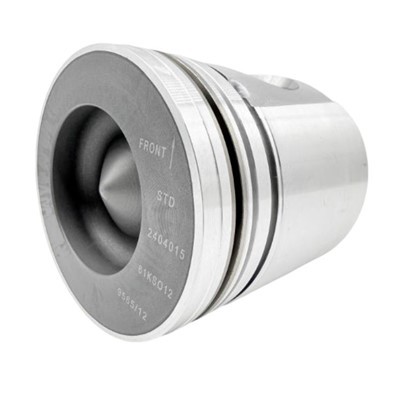
The piston in a car engine is one of the main components. Together with piston rings, piston pins, and other parts, it forms the piston assembly. Together with the cylinder head, it forms the combustion chamber, bearing the force of the combustion gases and transmitting power to the crankshaft via the piston pin and connecting rod to complete the working process of the internal combustion engine.
Because the piston operates in a harsh environment of high speed, high pressure, and high temperature, and considering the smooth operation and durability of the engine, the piston must have sufficient strength and rigidity, good thermal conductivity, high heat resistance, a low coefficient of expansion (small changes in size and shape), low relative density (light weight), wear resistance, corrosion resistance, and low cost.
Due to the numerous and high requirements, some of which are contradictory, it is difficult to find a piston material that can completely meet all the requirements. Modern engine pistons are generally made of aluminum alloy because aluminum alloy has the outstanding advantages of low density and good thermal conductivity. However, it also has the disadvantages of a relatively high coefficient of expansion and relatively poor high-temperature strength. These disadvantages can only be addressed through reasonable structural design to meet the usage requirements. Therefore, the quality of a car engine depends not only on the materials used but also on the rationality of its design.