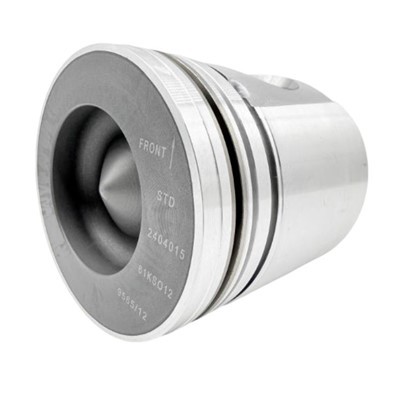
As automobile manufacturers place increasingly stringent demands on engine power, fuel economy, environmental performance, and reliability, pistons have evolved into high-tech products integrating lightweight, high-strength new materials, complex external cylindrical surfaces, and custom-designed pin holes. These advancements ensure the piston's heat resistance, wear resistance, smooth guiding function, and excellent sealing, thereby reducing engine friction losses and lowering fuel consumption, noise, and emissions.
To meet the above functional requirements, the outer circle of the piston is typically designed as an irregular shape (convex to elliptical), meaning the cross-section perpendicular to the piston axis is an ellipse or a modified ellipse, with the ellipticity varying according to a certain pattern along the axial direction, achieving an ellipticity accuracy of 0.005 mm. The outer contour of the piston's longitudinal section is a fitted curve of a high-order function, with a contour accuracy of 0.005–0.01 mm. To improve the piston's load-bearing capacity and thus increase the engine's power output, the pin hole of high-load pistons is typically designed as a micro-conical or normal-stress curved surface (irregular pin hole), with a pin hole dimensional accuracy of IT4 grade and a contour accuracy of 0.003 mm.
As a typical key automotive component, the piston has strong technological characteristics in terms of machining. The domestic piston manufacturing industry typically consists of machining production lines composed of general-purpose machine tools and specialized equipment tailored to the piston's technological characteristics. Therefore, specialized equipment becomes the key equipment in piston machining, and its function and precision directly affect the quality indicators of the final product's key properties.