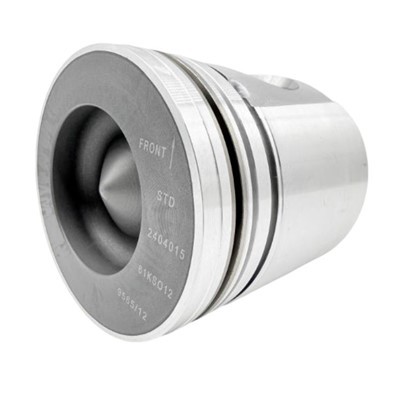
Piston ring clearance is divided into end clearance, side clearance, and rear clearance.
The standard value for end clearance is 0.25~0.30mm, with a limit of 0.35mm; the side clearance is 0.04~0.10mm.
The side clearance of the oil ring is smaller than that of the air ring, while its tooth clearance is 0.50~1.00mm.
The tooth clearance of the oil ring is larger than that of the air ring to increase the clearance of the oil accumulation area, which helps prevent oil leakage caused by decompression.
During engine operation, piston rings undergo thermal expansion due to contact with high-temperature gases, resulting in radial expansion and contraction deformation under the action of periodic reciprocating motion. Therefore, to ensure normal operation, piston rings must have a standard clearance within the cylinder.
Piston rings are divided into compression rings and oil rings. Compression rings are used to seal the combustible mixture in the combustion chamber, while oil rings are used to remove excess oil from the cylinder. Piston rings are metal rings used to fit inside the piston grooves.