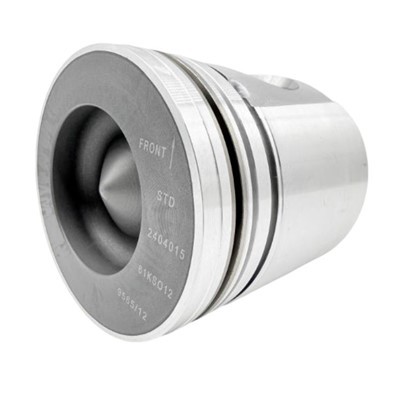
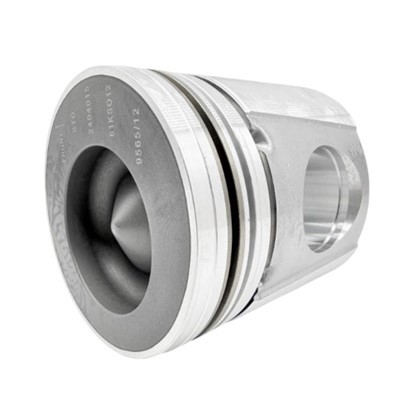
The basic structure of a piston is closely related to its role in an internal combustion engine, and it is one of the most critical moving parts in the engine. The piston reciprocates within the cylinder, forming the combustion chamber together with the cylinder head and cylinder walls, bearing the responsibility for the compression, combustion, and emission of the fuel-air mixture. The performance and structure of the piston directly affect the power, economy, emissions performance, and reliability of the internal combustion engine. Therefore, a thorough analysis of the basic structure of the piston helps to better understand the working principle of the internal combustion engine and optimize its design.
1. Piston Head
The piston head is the upper part of the piston, usually hemispherical or flat. It forms the combustion chamber between itself and the cylinder head, which is the main area for the combustion of the fuel-air mixture. The shape and size of the piston head have a significant impact on the combustion process. Generally, a larger piston head area provides more combustion space, which is conducive to the complete combustion of fuel, thereby improving engine power. However, an excessively large piston head area can also lead to increased heat loss and reduced engine thermal efficiency. Therefore, these factors need to be balanced when designing the piston head to achieve optimal performance.
In addition, the piston head has piston ring grooves for installing piston rings. The main function of piston rings is to seal the combustion chamber, preventing combustion gases from leaking into the crankcase. They also play a role in oil scraping, heat dissipation, and reducing wear. The type and number of piston rings also affect piston performance. Generally, multiple piston rings provide better sealing, but also increase friction loss and manufacturing costs. Therefore, in practical applications, the appropriate piston ring configuration needs to be selected based on the engine's operating requirements and performance goals.
2. Piston Skirt
The piston skirt is the lower part of the piston, cylindrical in shape. It forms a sliding fit with the cylinder wall, bearing side pressure and friction. The shape and size of the piston skirt have a significant impact on the piston's motion stability and wear. To reduce friction loss and improve wear resistance, piston skirts typically use special materials and surface treatment processes. For example, aluminum alloy piston skirts may undergo hard anodizing or be coated with a wear-resistant coating to increase their surface hardness; cast iron piston skirts may use processes such as laser hardening to improve their wear resistance.
In addition, the piston skirt is equipped with oil holes and oil grooves for lubrication and cooling. Lubricating oil enters the gap between the piston skirt and the cylinder wall through the oil holes, forming an oil film for lubrication; simultaneously, the lubricating oil also carries away some heat, contributing to cooling. The design and arrangement of these oil holes and grooves are also key factors affecting piston performance.
3. Piston Pin Seat
The piston pin seat is the middle part connecting the piston head and the piston skirt, and it is also the installation location of the piston pin. The piston pin is an important component connecting the piston and connecting rod, bearing alternating tensile and compressive loads. Therefore, the piston pin seat must have sufficient strength and rigidity to ensure reliable piston pin fixation and torque transmission. At the same time, the design of the piston pin seat also needs to consider lubrication and heat dissipation. Generally, the piston pin seat contains lubricating oil channels and heat sinks to ensure good lubrication and cooling conditions for the piston pin. These design details are crucial for improving the piston's durability and reliability.
These three parts each perform different functions and roles, together constituting the piston, a key moving component. During the design and manufacturing process, it is necessary to fully consider the impact of factors such as the shape, size, material, and process of each part on the piston performance in order to achieve the best performance.