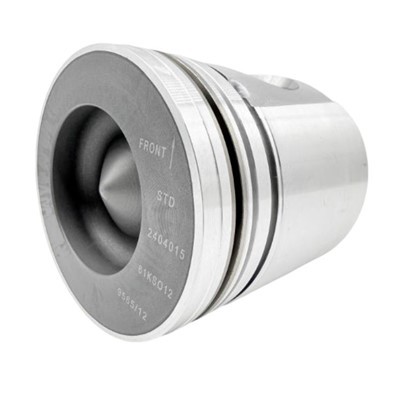
The entire piston can be mainly divided into three parts: the piston crown, the piston head, and the piston skirt.
The primary function of the piston is to withstand the combustion pressure in the cylinder and transmit this force to the crankshaft through the piston pin and connecting rod. In addition, the piston, along with the cylinder head and cylinder walls, forms the combustion chamber.
The piston crown is a component of the combustion chamber and is therefore often manufactured in different shapes. Gasoline engine piston crowns are mostly flat or concave to ensure a compact combustion chamber structure, small heat dissipation area, and simple manufacturing process. Convex pistons are commonly used in two-stroke gasoline engines. Diesel engine piston crowns are often made with various recesses.
The piston head is the part above the piston pin seat. Piston rings are installed on the piston head to prevent high-temperature, high-pressure combustion gases from entering the crankcase and to prevent engine oil from entering the combustion chamber. Most of the heat absorbed by the piston crown is also transferred to the cylinder through the piston head and then dissipated through the cooling medium.
The piston head is machined with several ring grooves for installing piston rings. The number of piston rings depends on the sealing requirements and is related to the engine speed and cylinder pressure. High-speed engines have fewer piston rings than low-speed engines, and gasoline engines have fewer piston rings than diesel engines. Generally, gasoline engines use two compression rings and one oil ring; diesel engines use three compression rings and one oil ring; low-speed diesel engines use three to four compression rings. To reduce friction losses, the height of the piston ring section should be minimized, and the number of rings should be reduced as much as possible while ensuring sealing.
The entire portion below the piston ring grooves is called the piston skirt. Its function is to guide the piston's reciprocating motion in the cylinder and withstand lateral pressure. During engine operation, the piston undergoes bending deformation due to the pressure of the gas inside the cylinder. When the piston is heated, its expansion is greater at the piston pin due to the higher metal content. Furthermore, the piston undergoes compressive deformation under lateral pressure. The combined result of these deformations makes the piston skirt cross-section an ellipse with its major axis perpendicular to the piston pin direction. In addition, because the temperature and mass distribution along the piston axis is uneven, the thermal expansion of each cross-section is greater at the top and smaller at the bottom.