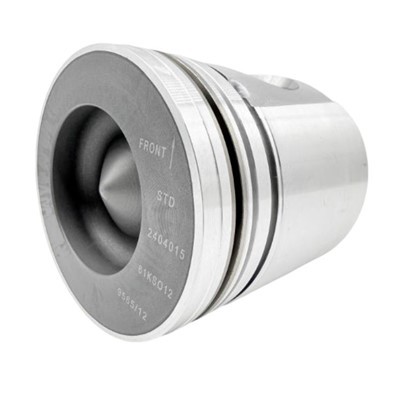
The axis of the piston pin bore does not intersect the piston centerline; the deviation between these two centerlines is the piston pin offset. Internal combustion engine engineering defines the side of the piston that contacts the cylinder wall during its downward stroke as the primary thrust surface, and the side that contacts the cylinder wall during its upward stroke as the secondary thrust surface.
When the piston's compression stroke ends and the power stroke begins, the piston transitions from contacting the cylinder wall with the secondary thrust surface to contacting it with the primary thrust surface. Under the pressure of the combustible mixture's combustion and expansion, the piston will knock against the cylinder wall, producing noise. To solve this knocking noise problem, designers shift the axis of the piston pin bore towards the primary thrust surface by approximately 1 millimeter. With this design, during piston reversal, due to the lever principle, the skirt of the primary thrust surface will contact the cylinder wall first, effectively preventing knocking noise within the cylinder.
If the piston pin centerline is offset, the piston must be installed in the specified direction regardless of whether there is a groove on the top of the piston to avoid valve clearance, in order to avoid the engine making knocking noise during operation.